| |  | | | Piraino Enterprises A Quick reference to Computer Cables and Connections.
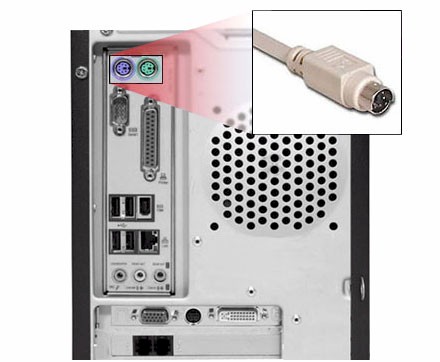
| | | The PS/2 Ports are simple, 6-pin, low-speed serial connections commonly dedicated to a keyboard and mouse. Although these ports may look identical at first glance, they are not interchangable, so you'll need to be extremely careful to attach the keyboard and mouse to their respective PS/2 port. If you elect to use a USB keyboard and mouse, you can typically disable the PS/2 ports in the system's CMOS setup and free the PS/2 system resources for other devices.
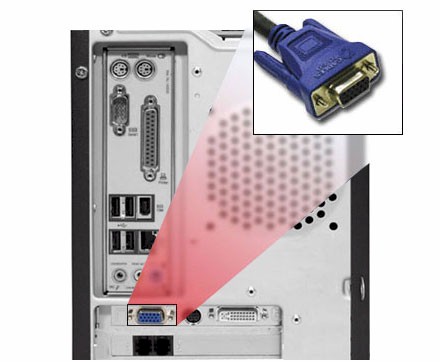
 Back to Top | | | | Video Graphics Array: used to connect the monitor to the computer. Some other value-add information to go here! VGA stands for Video Graphics Array. VGA, although now more advanced, has become the standard for desktop video, leaving both the MCGA and 8514 in the dust. VGA offers clean images at higher resolutions. The standard VGA can produce as many as 256 colors at a time from a palette of 262,144 colors. The original VGA, though, had to be at a 320x400 resolution to display this amount of color. At the standard 640x480 resolution, it was only capable of 16 colors at a time. Also, VGA extends into the monochrome world. It uses color summing to translate color graphics into graphics using 64 different shades of grey. This, in effect, simulates color on a monochrome monitor. VGA requires a VGA monitor, or one capable of accepting the analog output of a VGA card.
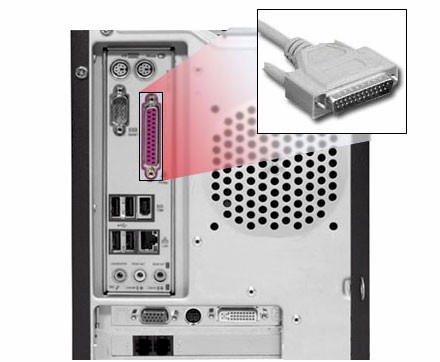
 Back to Top | | | | The parallel port originally started out as a undirectional (output only) port running at about 150K/sec. and appeared as an interface card for the Apple. It migrated to the IBM PC unchanged except for a switch from the original 36-pin Amphenol connector, which it has retained through the years.
Refers to processes that occur simultaneously. Printers and other devices are said to be either parallel or serial. Parallel means the device is capable of receiving more than one bit at a time (that is, it receives several bits in parallel). Most modern printers are parallel.
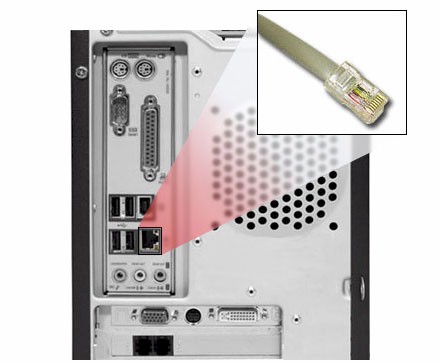
 Back to Top | | | | A local-area network (LAN) architecture developed by Xerox Corporation in cooperation with DEC and Intel in 1976. Ethernet uses a bus or star topology and supports data transfer rates of 10 Mbps. The Ethernet specification served as the basis for the IEEE 802.3 standard, which specifies the physical and lower software layers. Ethernet uses the CSMA/CD access method to handle simultaneous demands. It is one of the most widely implemented LAN standards.
A newer version of Ethernet, called 100Base-T (or Fast Ethernet), supports data transfer rates of 100 Mbps. And the newest version, Gigabit Ethernet supports data rates of 1 gigabit (1,000 megabits) per second.
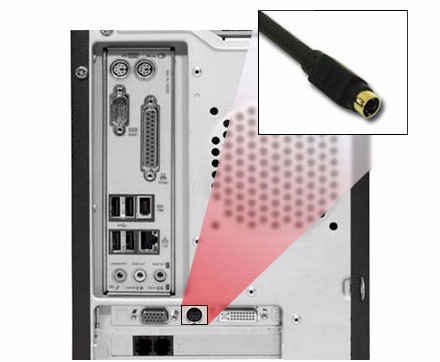
Back to Top | | | | Short for Super-Video, a technology for transmitting video signals over a cable by dividing the video information into two separate signals: one for color (chrominance), and the other for brightness (luminance). When sent to a television, this produces sharper images than composite video , where the video information is transmitted as a single signal over one wire. This is because televisions are designed to display separate Luminance (Y) and Chrominance (C) signals. (The terms Y/C video and S-Video are the same.)
Computer monitors, on the other hand, are designed for RGB signals. Most digital video devices, such as digital cameras and game machines, produce video in RGB format. The images look best, therefore, when output on a computer monitor. When output on a television, however, they look better in S-Video format than in composite format. To use S-Video, the device sending the signals must support S-Video output and the device receiving the signals must have an S-Video input jack. Then you need a special S-Video cable to connect the two devices.
Back to Top | | | | Short for Digital Visual Interface, a digital interface standard created by the Digital Display Working Group (DDWG) to convert analog signals into digital signals to accommodate both analog and digital monitors. Data is transmitted using the transition minimized differential signaling (TMDS) protocol, providing a digital signal from the PC's graphics subsystem to the display. The standard specifies a single plug and connector that encompass both the new digital and legacy VGA interfaces, as well as a digital-only plug connector. DVI handles bandwidths in excess of 160 MHz and thus supports UXGA and HDTV with a single set of links. Higher resolutions can be supported with a dual set of links.
(2) Short for Digital Video Interactive, a now-defunct technology developed by General Electric that enables a computer to store and display moving video images like those on television. The most difficult aspect of displaying TV-like images on a computer is overcoming the fact that each frame requires an immense amount of storage. A single frame can require up to 2MB (megabytes) of storage. Televisions display 30 frames per second, which can quickly exhaust a computer's mass storage resources. It is also difficult to transfer so much data to a display screen at a rate of 30 frames per second. DVI overcomes these problems by using specialized processors to compress and decompress the data. DVI is a hardware -only codec (compression/decompression) technology. A competing hardware codec, which has become much more popular, is MPEG. Intel has developed a software version of the DVI algorithms, which it markets under the name Indeo. 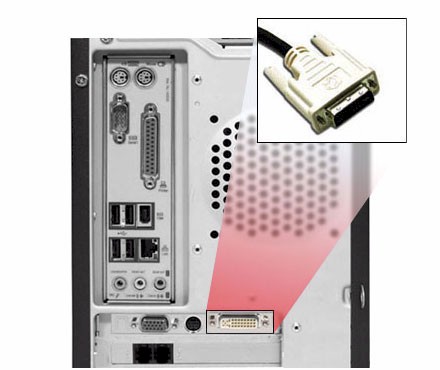
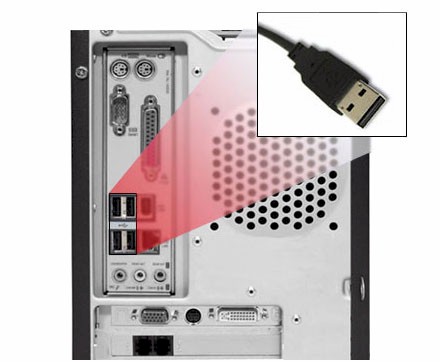
Back to Top | | | | Universal Serial Bus: a protocol for transferring data to and from digital devices. Many digital cameras and memory card readers connect to the USB port on a computer. USB card readers are typically faster than cameras or readers that connect to the serial port, but slower than those that connect via FireWire. an external bus standard that supports data transfer rates of 12 Mbps. A single USB port can be used to connect up to 127 peripheral devices, such as mice, modems, and keyboards. USB also supports Plug-and-Play installation and hot plugging.
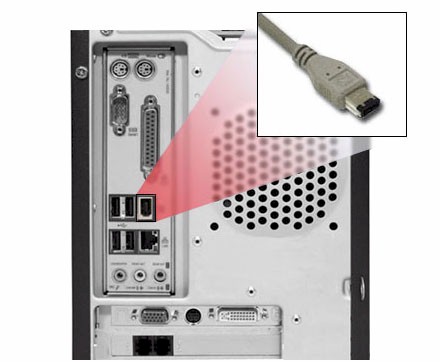
Back to Top | | | Firewire IEEE 1394 Port A type of cabling technology for transferring data to and from digital devices at high speed. Some professional digital cameras and memory card readers connect to the computer over FireWire. FireWire card readers are typically faster than those that connect via USB. Also known as IEEE 1394, FireWire was invented by Apple Computer but is now commonly used with Windows-based PCs as well.
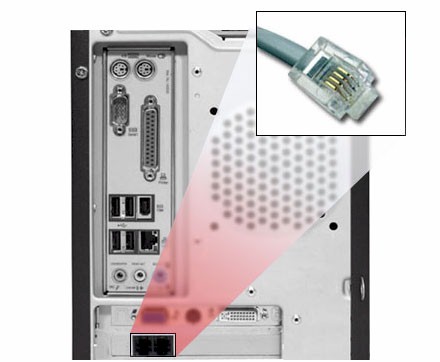
 Back to Top | | | | Short for Registered Jack-11, a four- or six-wire connector used primarily to connect telephone equipment in the United States. RJ-11 connectors are also used to connect some types of local-area networks (LANs), although RJ-45 connectors are more common.
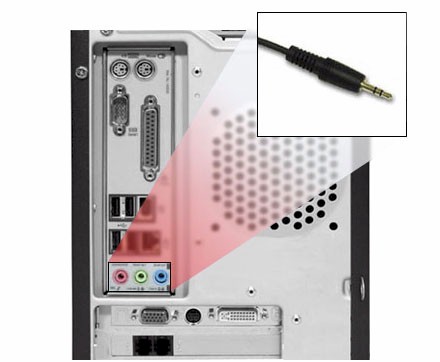
 Back to Top | | | | Audio connectors are used to affix cables to other audio equipment, providing electronic signal transference and grounding protection. Connectors may be plugs, jacks, or combinations, and may have an integral switch. Plug type audio connectors are a plug, or male, connector includes pins that can be inserted into a socket. Jack type audio connectors are a jack, or female, connector consists of sockets that are aligned to mesh with a pin-type connector. Combination plug and jack connectors are also available. They may also have switches. Includes adapters and Y-adapters. Applications for audio connectors can be general purpose, telephone, or microphone. Most audio connectors are for commercial purposes, but some may conform to military specifications.
Back to Top | | | Still have Questions?
Give Us A Call Now (312) 719-0777
Or contact us for an initial consultation at no charge.
| | |  |